
Do Massage Guns Work? An Honest Look at the Research
Disclosure: StayWellAware may earn a commission if you buy through links on this page, at no extra cost to you. It never affects what we recommend. Read our full disclosure.
Not medical advice. This article is general information. If you have an injury, ongoing pain, a blood clotting problem, take blood thinners, have osteoporosis, or have a medical device or condition you’re unsure about, talk to your doctor or physical therapist before using a massage gun.
Massage guns have gone from pro locker rooms to kitchen drawers in a few short years. You’ve seen them in gyms, on social media, maybe under the Christmas tree. They hum, they thump, and for a lot of people they simply feel good after a long run or a day hunched over a desk.
But “feels good” and “speeds up recovery” are different claims. If you’re thinking about spending real money on one, it’s worth knowing what the research says, and what it doesn’t.
We haven’t tested massage guns hands-on for this article. It’s based on the published studies listed at the end.
The short version
- Evidence level: Limited. There are now several systematic reviews, but they’re built on small, short studies of mixed quality, mostly in young, healthy, active adults.
- Flexibility and range of motion: the most consistent finding. Massage guns appear to help short-term flexibility in some muscle groups.
- Soreness after hard exercise: mixed. Some studies show short-term relief; a 2026 meta-analysis found no clear benefit for delayed-onset muscle soreness overall.
- Strength: no clear benefit for recovering maximum strength, and one review suggests not using them right before strength, balance, or explosive activities.
- Safety: generally low-risk for healthy people used gently, but there are good reasons to check with a clinician first if you have certain conditions (see below).
- Bottom line: a reasonable comfort tool if you enjoy it. Not a must-have, and not a replacement for sleep, good training, and time.
What a massage gun does
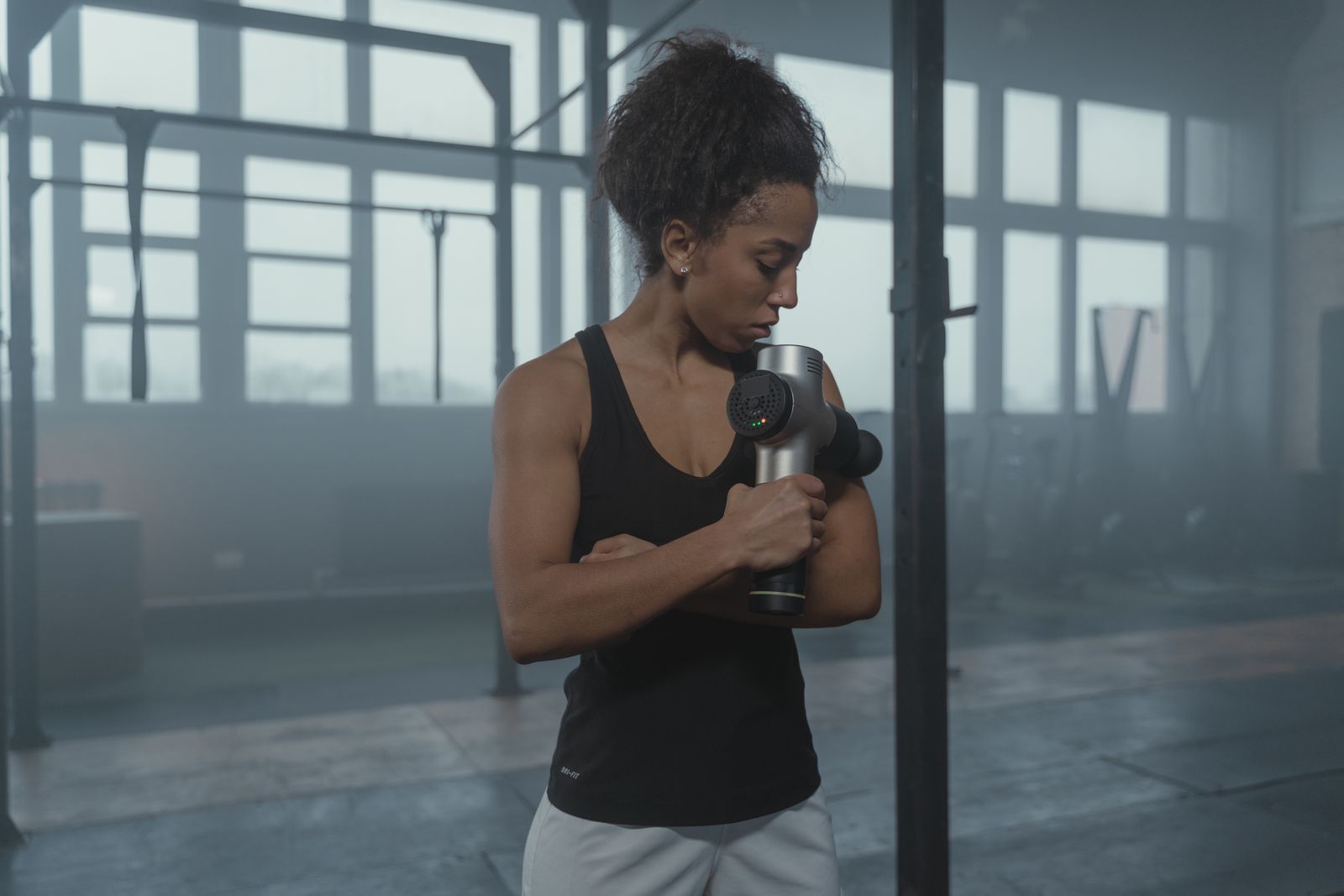
A massage gun is a handheld device with a head that moves rapidly back and forth, delivering quick pulses into the muscle. Researchers often call this “percussive therapy.” The idea is similar to some hands-on massage techniques: reduce tightness, change how the muscle feels, and maybe ease soreness.
Brands compete on speed settings, how deep the head travels, how hard you can press before it stalls, attachments, noise and battery life. Those specs matter for comfort and convenience. What we care about here is the bigger question: does the basic idea work?
What the research shows
The 2023 systematic review in JFMK
A 2023 systematic review in the Journal of Functional Morphology and Kinesiology searched several research databases for studies on massage guns (PubMed). Out of 281 records screened, only 11 studies made the cut. Ten had a moderate risk of bias and one had a high risk.
The authors’ conclusions:
- Massage guns could help flexibility in muscles including the hip flexors, hamstrings, and calves.
- For strength, balance, acceleration, agility, and explosive activities, they either showed no improvement or even a decrease in performance.
- After a fatiguing exercise protocol, they helped with some recovery-related measures, such as reducing stiffness and improving range of motion and strength.
- No differences were found in contraction time, perceived exertion or blood lactate.
The review’s practical takeaway: massage guns can help improve short-term range of motion, flexibility and some recovery measures, but the authors didn’t recommend them for strength, balance, acceleration, agility or explosive activities.
The 2023 review in the International Journal of Sports Physical Therapy
Another 2023 systematic review, in the International Journal of Sports Physical Therapy, included 13 studies (PubMed). The authors noted that all of the studies had limitations in method or reporting. They found an association between a single massage gun session and short-term increases in muscle strength, explosive strength and flexibility, and found that multiple sessions were linked to reduced musculoskeletal pain.
Notice that this review is more upbeat about strength than the first one. That’s a sign of how unsettled the evidence is: small studies, different devices, different settings, and different ways of measuring outcomes.
The 2026 meta-analysis on recovery
The most recent look we found is a 2026 systematic review and meta-analysis in Chiropractic & Manual Therapies that pooled 12 randomized controlled trials on recovery after exercise-induced muscle damage (Springer). It found:
- Better recovery of jump performance compared with control (rated low certainty).
- Lower levels of creatine kinase, a blood marker of muscle damage (very low certainty).
- No clear improvement in recovering maximum strength (moderate certainty).
- No clear improvement in delayed-onset muscle soreness (very low certainty).
The authors were careful to say that their findings about “dose” (how long and at what speed) are preliminary and shouldn’t be read as rules.
A study that found little effect
One of the larger single studies, published in the Journal of Athletic Training, asked 65 active young adults to use a massage gun for five minutes on one calf after hard exercise, leaving the other leg as a comparison (PubMed). Massage gun use made little difference to range of motion, strength, endurance, or soreness. In fact, there was a small increase in perceived soreness in the treated leg immediately and four hours afterward. The authors suggested caution about using massage guns right after strenuous lower-body exercise.
And one that found short-term relief
A small study in the Journal of Sports Science and Medicine gave 17 untrained college-aged adults a hard eccentric arm workout (JSSM). The nine who received one-minute percussive massage sessions over the following three days regained range of motion faster than the eight who rested, and got an immediate, temporary drop in soreness each time. Strength wasn’t affected, and the massage didn’t speed up the underlying soreness recovery until the 72-hour mark.
Putting it together
When you line up these studies, a fairly consistent picture appears:
- Massage guns probably help you feel looser for a while. Short-term flexibility and range of motion are the most consistent benefits.
- They may give temporary soreness relief, but there’s no clear evidence they make sore muscles heal faster overall.
- They don’t appear to help you recover strength faster, and using one right before a heavy lift, sprint, or balance-heavy activity may not help.
- Most of the research is in young, healthy, active people. There’s very little evidence for older adults or for people with chronic pain conditions.
- The studies are small and often low quality. New research could shift these conclusions.
That’s not nothing. If a massage gun makes you feel better, helps you move more comfortably, and gets you back to the activities you enjoy, that can be worth a lot. Just be clear on what you’re buying: a comfort and mobility tool, not a recovery shortcut.
Who should be careful
We couldn’t find formal safety guidelines specific to massage guns from a major health body. But Mayo Clinic’s guidance on massage in general lists situations where people should talk to their health care provider first, including bleeding disorders or low platelet counts, taking blood thinners, deep vein thrombosis (blood clots), healing fractures, burns or open wounds, and severe osteoporosis (Mayo Clinic). It’s sensible to apply the same caution to a device that delivers strong, repeated pressure.
Common-sense rules if you try one:
- Start on the lowest setting and use light pressure.
- Keep it on muscle, away from bones, joints, the front and sides of the neck, and the spine itself.
- Don’t use it on a fresh injury, a swollen or bruised area, or anywhere with numbness.
- Keep sessions short. Many studies used a few minutes per muscle group.
- Stop if it hurts in a sharp or unusual way.
- Never use it on a calf that’s swollen, warm, red, or painful without a clear reason. Those can be signs of a blood clot, which needs urgent medical attention, not massage.
- Follow the manufacturer’s instructions, including any warnings about pregnancy, implanted devices, or medical conditions.
If you decide to buy one
Specs vary a lot between models, and price doesn’t always track usefulness. Things to think about:
- Weight and grip. Reaching your own back or shoulders is awkward with a heavy device. If you have arthritis in your hands, try one in a store if you can.
- Noise. Some models are much louder than others.
- Speed range. A low starting speed is useful for sensitive areas and beginners.
- Attachments. A soft or wide head is gentler; you don’t need a drawer full of them.
- Battery and charging. Check how it charges and whether the battery can be replaced.
- Warranty and returns. Worth checking, given the cost of premium models.
Therabody
We may link to Therabody, which makes the Theragun line of percussive massage devices along with other recovery products. Therabody sells several Theragun models at different sizes and price points. We haven’t tested them ourselves, so we’re not ranking them against other brands. Compare models on weight, noise, speed range and warranty, and think about which features you’ll actually use.
[Check current price at Therabody]
Models and prices change often. Check current details on Therabody’s site.
Cheaper ways to get similar benefits
Before spending money, it’s fair to ask whether you need a powered device at all:
- Gentle movement the day after a hard workout, such as walking, an easy bike ride, or light stretching, is free.
- A foam roller or massage ball costs far less and targets many of the same areas.
- Good sleep matters for recovery. Most adults need at least seven hours, according to the CDC (CDC).
- Sensible training: increase load gradually, and build rest days into your week.
And if you have ongoing pain, a physical therapist can find the cause and give you a plan, which is worth far more than any gadget.
The bottom line
Massage guns aren’t magic, and they aren’t useless. The best evidence suggests they can improve flexibility and range of motion for a short time and may ease soreness temporarily, but they don’t clearly speed up recovery of strength or prevent muscle soreness. If you enjoy one and use it gently, it can be a pleasant part of your routine. If money is tight, a foam roller, an easy walk, and a good night’s sleep will cover most of the same ground.
Sources
- Ferreira RM, et al. The Effects of Massage Guns on Performance and Recovery: A Systematic Review. J Funct Morphol Kinesiol. 2023;8(3):138. https://pubmed.ncbi.nlm.nih.gov/37754971/ (full text: https://pmc.ncbi.nlm.nih.gov/articles/PMC10532323/)
- Sams L, et al. The Effect of Percussive Therapy on Musculoskeletal Performance and Experiences of Pain: A Systematic Literature Review. Int J Sports Phys Ther. 2023. https://pubmed.ncbi.nlm.nih.gov/37020441/
- Effects of percussive therapy dosages on recovery from acute exercise-induced muscle damage: a systematic review and meta-analysis. Chiropractic & Manual Therapies. 2026. https://link.springer.com/article/10.1186/s12998-026-00657-9
- Leabeater AJ, et al. Under the Gun: Percussive Massage Therapy and Physical and Perceptual Recovery in Active Adults. J Athl Train. 2024. https://pubmed.ncbi.nlm.nih.gov/37248364/
- Roberts TD, Costa PB, Lynn SK, Coburn JW. Effects of Percussive Massage Treatments on Symptoms Associated with Eccentric Exercise-Induced Muscle Damage. J Sports Sci Med. 2024;23(1):126. https://www.jssm.org/volume23/iss1/cap/jssm-23-126.pdf
- Mayo Clinic. Massage therapy. https://www.mayoclinic.org/tests-procedures/massage-therapy/about/pac-20384595
- Centers for Disease Control and Prevention. Sleep. https://www.cdc.gov/sleep/
Written by Mbatia Tony Muitungu. Read how we research and update articles in our Editorial Policy.
